

A single payment gateway may be enough for a merchant operating in one market with a limited payment-method mix. The decision becomes more complicated when the business adds countries, currencies, wallets, local payment methods, recurring billing, or a second acquiring relationship.
At that point, the central question is no longer simply which gateway should process the transaction? It becomes: how should each transaction be routed, authenticated, monitored, recovered, and reconciled across the entire payment stack?
That is the role of payment orchestration. This guide explains how it works, what it can realistically improve, when a merchant needs it, and what to evaluate before choosing a payment orchestration platform.
Key takeaways
- Payment orchestration is a control and decisioning layer above connected gateways, PSPs, processors, acquirers, and alternative payment rails.
- It can centralize routing, failover, retries, authentication, tokenization, reporting, and payment-method management through one integration.
- Smart routing may improve payment performance, but results depend on the merchant's markets, providers, transaction mix, rules, and data quality.
- Orchestration is most valuable when provider dependency, cross-border complexity, high transaction volume, or payment-method fragmentation create measurable operational risk.
- A platform should be evaluated on provider connectivity, routing transparency, token portability, reporting, support, onboarding, and the ability to migrate away if requirements change.
What is payment orchestration?
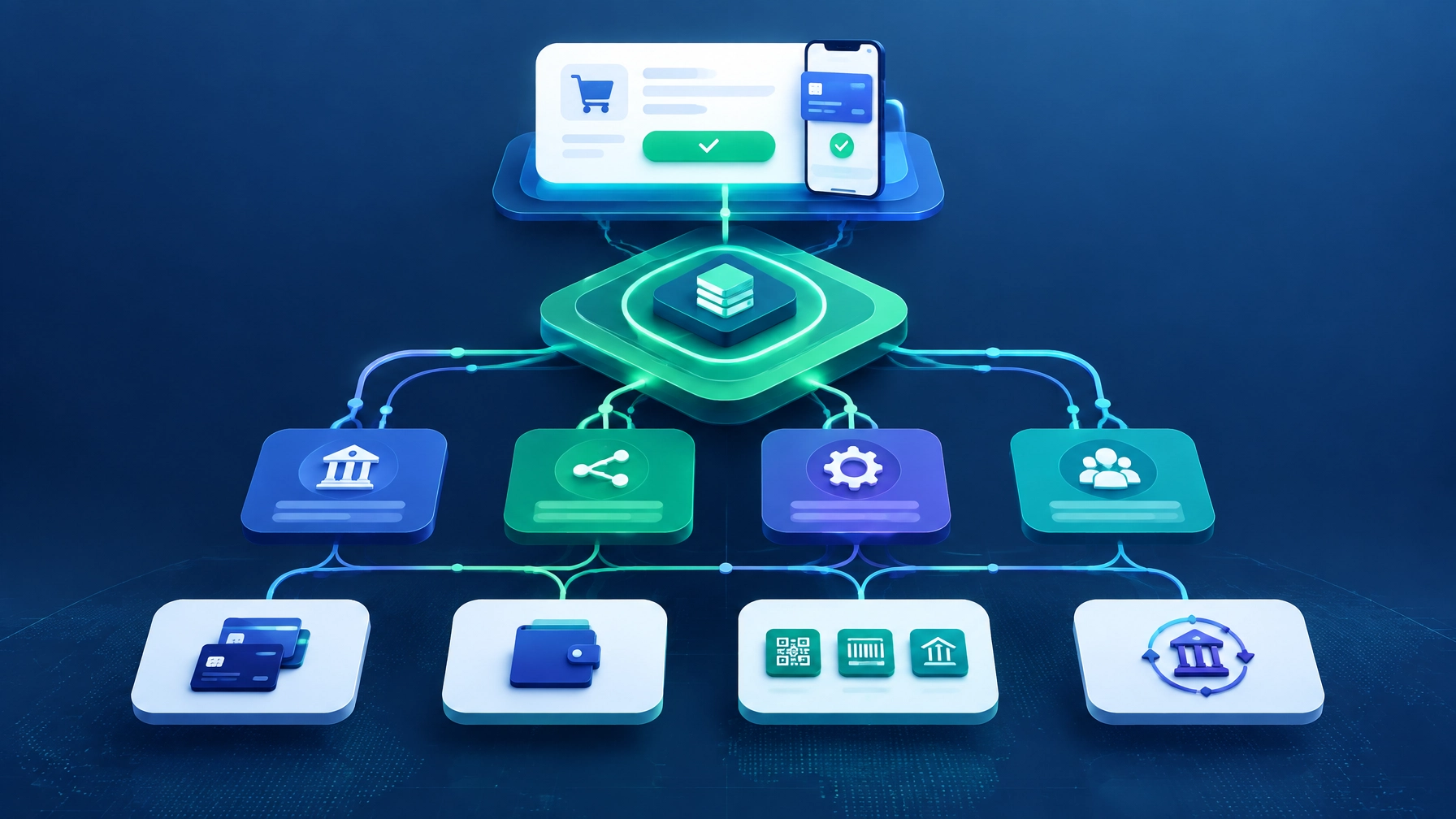
Payment orchestration is a technology layer that coordinates multiple payment connections from a centralized environment.
Rather than integrating separately with every gateway, payment service provider, acquirer, wallet, bank-payment rail, and risk tool, the merchant connects to an orchestration layer. That layer then applies configured rules to determine:
- Which provider should receive a transaction
- Which payment method should be displayed
- Whether authentication or 3D Secure should be triggered
- When a transaction can be retried
- Whether a failed transaction should be cascaded to another route
- How provider performance, costs, disputes, and settlements should be reported
The orchestration layer does not replace every participant in the payment chain. It coordinates them.
Industry coverage in 2026, including Yuno's enterprise playbook and Juspay's analysis of global merchants, increasingly describes orchestration as an enterprise control layer rather than simply a technical integration tool.
That distinction matters. A unified API can reduce development work, but orchestration becomes commercially valuable when it also gives the merchant control over routing, resilience, payment-method coverage, and performance analysis.
What a payment orchestration platform actually does
A payment orchestration platform normally sits between the merchant's checkout or payment gateway API and a group of connected payment providers.
A simplified transaction flow looks like this:
- A customer selects a payment method at checkout.
- The merchant sends the payment request to the orchestration layer.
- The platform evaluates relevant data, such as market, currency, card or wallet type, amount, risk signals, and provider availability.
- A routing rule selects an appropriate gateway, PSP, acquirer, or payment rail.
- Authentication and risk checks are applied according to the transaction and market.
- The selected provider attempts authorization.
- If the response is a permitted soft decline, timeout, or technical failure, the orchestration layer may apply a retry or fallback rule.
- The final status, provider response, refund, dispute, and settlement information are returned to the merchant's systems.
The exact sequence depends on the merchant's configuration, provider capabilities, scheme rules, and regulatory requirements. Not every decline should be retried, and a poorly configured retry strategy can create duplicate transactions, unnecessary costs, or increased risk.
Payment orchestration vs payment gateway, PSP, processor, and acquirer
The terms in the payment stack are often used interchangeably, although they describe different functions. Commercial definitions can overlap, so the following distinction is a practical one rather than a universal legal classification.
| Component | Primary role | What it usually does |
|---|---|---|
| Payment gateway | Technical connection | Securely transmits payment data between checkout software and connected payment services |
| Payment service provider (PSP) | Packaged payment service | May combine gateway access, processing, risk tools, acquiring relationships, and other services |
| Payment processor | Transaction processing | Handles authorization messaging and transaction data between the merchant, payment network, and financial institutions |
| Acquirer | Merchant-side acquiring relationship | Supports merchant card acceptance, submits transactions through the relevant network, and manages settlement and risk obligations |
| Payment orchestration layer | Coordination and decisioning | Connects and manages multiple providers, applies routing logic, supports fallback, and consolidates operational data |
A payment gateway may connect to one provider or several. A PSP may offer its own gateway and processing arrangement. An orchestrator may connect to multiple PSPs, gateways, acquirers, wallets, and local rails.
This is why payment orchestration vs payment gateway is not simply a comparison between two products. A gateway is primarily a connection point. Orchestration is a broader control layer that can manage several connection points.
How payment orchestration works in practice
Smart payment routing
Smart payment routing directs a transaction toward a provider or rail that fits the transaction's characteristics.
Routing rules may consider:
- Customer or issuer country
- Merchant entity and processing market
- Currency
- Card type or bank identifier
- Payment method
- Transaction value
- Recurring or one-time status
- Provider availability and latency
- Historical authorization performance
- Cost and settlement requirements
- Risk or authentication results
Some merchants use fixed rules, such as routing transactions from one region to a particular provider. More advanced setups use live performance data to adjust routing decisions.
Industry reports and vendor coverage have attributed roughly 5–15% authorization-rate improvement to AI-driven or dynamic routing in some implementations. That is an industry-reported range, not a universal result and not a Payvea guarantee. The commercial impact depends on the merchant's starting architecture, provider mix, transaction volume, issuer behavior, and quality of the routing data.
Payment failover and acquiring redundancy
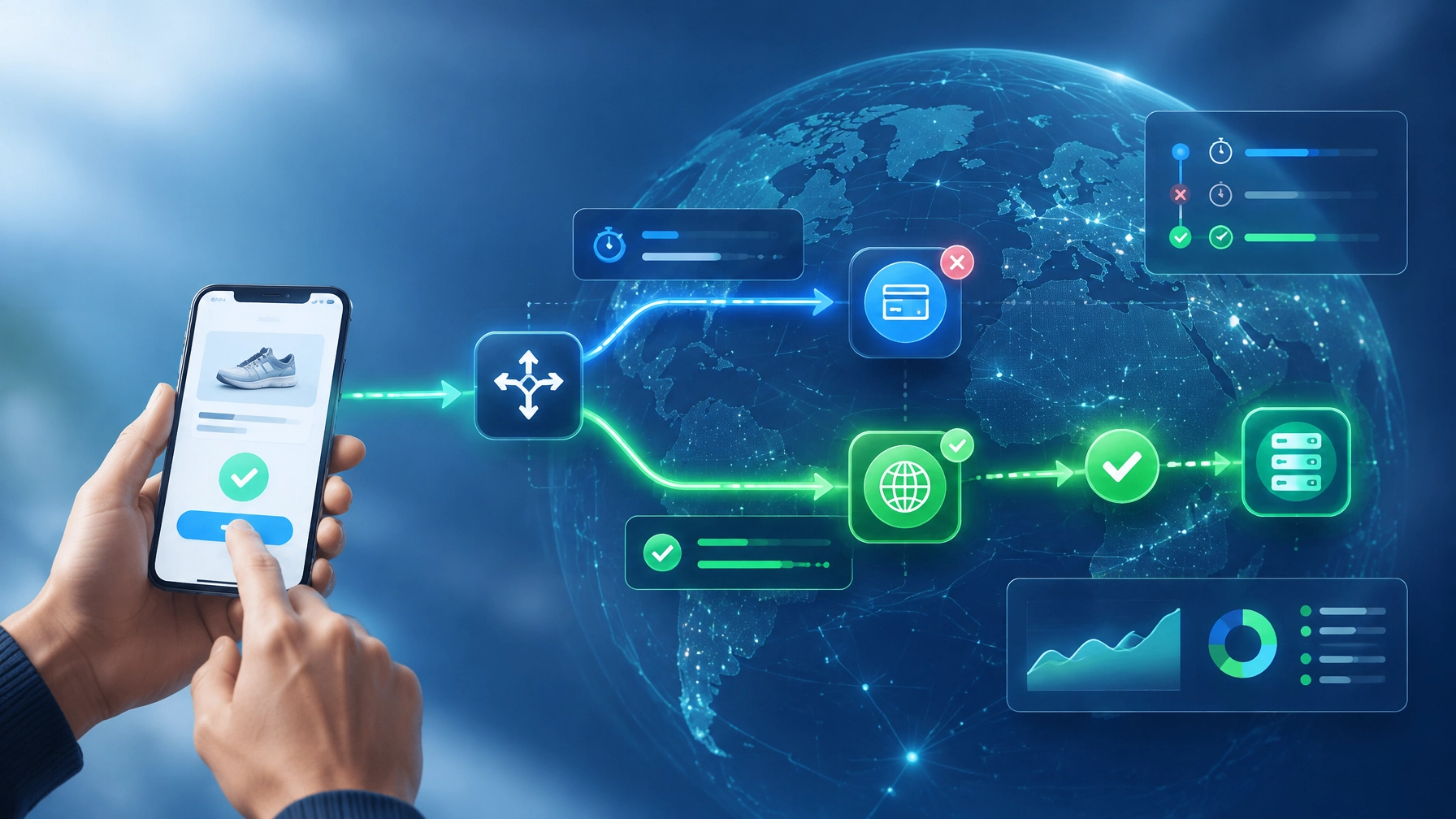
Payment failover allows traffic to move to another available route when a provider experiences an outage, timeout, capacity problem, or material performance degradation.
This is different from routing every transaction to the cheapest provider. A resilient setup considers whether a provider is available and suitable at the moment a payment is attempted.
Acquiring redundancy can reduce concentration risk, but it also introduces additional operational work. Providers may have different response codes, settlement reports, token formats, refund procedures, and underwriting requirements. The orchestration layer must normalize those differences without hiding important detail from the merchant's payments team.
Payment cascading and retries
Payment cascading is the controlled movement of a transaction from one route to another after an unsuccessful attempt.
A cascade may be considered after:
- A technical timeout
- A provider outage
- A permitted soft decline
- A temporary processing failure
It should not automatically be used after every hard decline. Repeating a transaction that has been rejected for a clear fraud, compliance, or account-related reason may increase risk rather than recover revenue.
Retry rules must also respect card-network requirements, provider agreements, customer consent, and the possibility that the first attempt was authorized even though the response was delayed. Good orchestration uses payment cascading selectively, with clear controls and monitoring.
Authentication and 3D Secure
Authentication is part of payment performance, not a separate afterthought.
An orchestration layer can help coordinate 3D Secure and other authentication steps across providers. It may apply rules based on market, transaction value, issuer behavior, exemptions, and risk signals.
The objective is not to remove authentication. It is to apply the appropriate level of friction while meeting applicable requirements. Poorly configured authentication can increase abandonment, while insufficient controls can increase fraud exposure and dispute risk.
Tokenization and recurring payments
Tokenization replaces sensitive payment credentials with a token that can be used for supported future transactions.
For subscriptions, marketplaces, and businesses with repeat customers, tokenization can simplify recurring payments and reduce the need to handle raw card data. However, token portability must be examined carefully. A token created by one provider may not automatically work with another provider.
Merchants should ask:
- Who owns or controls the token vault?
- Can tokens be migrated if the provider relationship changes?
- Are network tokens supported?
- Can recurring-payment credentials be used across connected routes?
- What happens to tokens after a contract ends?
The answers can determine whether orchestration reduces provider lock-in or merely moves it to a different layer.
Reporting, reconciliation, and settlement visibility
Multiple providers often produce different reports, identifiers, fee structures, refund statuses, and settlement files.
A useful orchestration platform should normalize operational data while preserving the source detail needed by finance, risk, and support teams. Reporting should help merchants compare:
- Authorization performance by provider, market, and method
- Decline reasons
- Latency and technical failures
- Refund and dispute activity
- Processing fees
- Settlement status
- Payment-method usage
- Recovery from retries or cascades
Centralized reporting does not necessarily mean centralized settlement. The acquiring or payment provider remains responsible for its own settlement arrangement, subject to the merchant's approved configuration.
Why global merchants use more than one provider
A single provider may be commercially appropriate for a smaller or less complex merchant. However, global businesses often add providers for three reasons.
Concentration risk
If one gateway, PSP, or acquirer becomes unavailable, the merchant may lose the ability to accept payments in affected markets. A second provider can provide resilience, although it must be properly integrated and approved.
Different provider strengths
One provider may perform well for domestic card transactions, while another may offer stronger coverage for a particular currency, issuer region, wallet, or local payment method.
Market and method coverage
Payment preferences vary substantially by market. Worldpay's 2026 Global Payments Report reports that digital wallets represented approximately 56% of global ecommerce transaction value. Its consumer research also indicates that roughly seven in ten consumers are less likely to purchase when their preferred local payment method is unavailable.
For merchants expanding internationally, payment-method selection is therefore part of market strategy. Local cards, bank payments, wallets, and open banking payments may need different provider connections and operational rules.
When does a merchant genuinely need orchestration?
A merchant may need orchestration when several of the following conditions apply:
- It operates across multiple countries or currencies.
- It depends on more than one PSP, gateway, or acquiring relationship.
- Provider outages or inconsistent performance create material revenue risk.
- It needs local and alternative payment methods in several markets.
- Its internal team lacks the capacity to maintain separate integrations.
- It requires centralized reporting across payment providers.
- It operates subscriptions, marketplaces, or complex recurring billing.
- It works in a regulated or high-risk sector where provider continuity matters.
- It is expanding and needs to add payment connections without rebuilding its checkout.
A single well-chosen gateway may be enough when the merchant has limited geographic scope, one primary payment method, modest volume, low provider concentration risk, and no immediate need for routing or failover.
The decision should be based on the cost of complexity compared with the cost of dependency. Orchestration adds a layer, so it should solve a clearly defined operational or commercial problem.
How to evaluate a payment orchestration platform
| Evaluation area | Questions to ask |
|---|---|
| Provider connectivity | Which gateways, PSPs, acquirers, wallets, and local rails are supported in the target markets? |
| Routing control | Can the merchant configure rules, test changes, view route decisions, and override automated logic? |
| Failover and cascading | Which failures trigger a fallback, and how are duplicate authorizations prevented? |
| Integration model | Is there a suitable payment gateway API, hosted payment page, plugin, or combination? |
| Tokenization | Are tokens portable, and who controls the vault and recurring-payment credentials? |
| Authentication | How are 3D Secure and market-specific authentication requirements managed? |
| Reporting | Can finance, risk, and payments teams see provider-level performance and settlement data? |
| Support and onboarding | Is technical support available during integration, testing, and provider changes? |
| Commercial model | Are orchestration fees separate from provider, acquiring, scheme, and foreign-exchange costs? |
| Exit path | Can the merchant export transaction data, rules, tokens, and operational history if it changes platforms? |
API integration vs hosted payment page
| Model | Advantages | Trade-offs |
|---|---|---|
| Payment gateway API | Greater control over checkout, payment-method presentation, and application workflows | Requires more development, testing, security planning, and ongoing maintenance |
| Hosted payment page | Faster implementation and reduced checkout-development requirements | Less control over the customer journey and page-level customization |
| Hybrid approach | Can combine a branded front end with hosted or provider-managed payment components | Requires careful responsibility mapping between merchant and platform |
Payvea provides unified payment gateway infrastructure through which businesses can connect supported acquirers, payment service providers, and alternative payment methods through one integration. Depending on the approved setup and supported partners, Payvea can provide access to more than 250 payment methods and over 100 currencies, with smart routing, failover logic, centralized reporting, and hands-on technical support.
Available providers, methods, currencies, tokenization features, and settlement arrangements depend on the merchant profile, connected partners, and supported markets.
Risks and limitations to consider
Payment orchestration is not a universal solution.
- Added complexity: Another layer requires clear ownership of incidents, data, credentials, refunds, and reconciliation.
- Cost: The platform fee must be assessed alongside acquiring, gateway, scheme, foreign-exchange, and support costs.
- Provider dependency remains: Orchestration improves flexibility, but the merchant still depends on the connected providers and their underwriting decisions.
- Data quality matters: Poor decline mapping, incomplete provider data, or insufficient transaction volume can weaken routing decisions.
- Automation requires governance: AI or dynamic routing should be monitored, tested, and subject to human oversight.
- Token portability may be limited: Moving providers can still require technical and commercial migration work.
- Approval is not guaranteed: Adding more routes does not mean every provider will support every business model, country, currency, or industry.
Payment orchestration for high-risk and regulated merchants
High-risk payment processing often requires more than finding a provider willing to review an application. Merchants may need to demonstrate licensing, ownership transparency, customer disclosures, refund procedures, transaction monitoring, chargeback controls, and sustainable processing history.
Orchestration can help by providing:
- More than one potential processing connection, where approved and available
- Centralized transaction monitoring
- Clearer provider-performance reporting
- Configurable authentication and risk workflows
- Operational continuity if a provider's capabilities change
- Support for complex payment-method and currency requirements
It does not bypass underwriting or make approval easier by default. A merchant's processing arrangement remains subject to provider approval, applicable regulations, and the requirements of the relevant market.
Risk monitoring is particularly important as card-network monitoring rules evolve. For example, Visa's VAMP fact sheet sets a 150-basis-point excessive-merchant threshold for several regions from 1 April 2026, with industry summaries describing a combined fraud-and-dispute event floor before the threshold applies. The precise rules vary by region and program scope.
This is context for better monitoring and payment governance, not a promise that orchestration prevents fraud, disputes, or chargebacks.
For businesses in areas such as iGaming, FX payment processing, digital services, or other regulated sectors, the relevant question is whether the proposed architecture supports transparent, compliant, and sustainable processing for the specific business model.
Frequently asked questions
Is payment orchestration the same as a PSP?
No. A PSP generally provides payment services through its own acquiring, processing, gateway, or partner arrangements. An orchestration layer is designed to coordinate multiple providers and routes from a centralized control layer.
Does payment orchestration guarantee higher authorization rates?
No. Smart routing and failover may improve performance in suitable circumstances, but outcomes depend on provider coverage, market, issuer behavior, transaction quality, risk rules, and configuration. Reported industry improvements should not be treated as guarantees.
Can a small merchant use payment orchestration?
Yes, but it may not be commercially necessary. A smaller merchant with one market and one well-performing provider may prefer a simpler gateway setup. Orchestration becomes more compelling as provider dependency, geographic scope, payment-method needs, and operational complexity increase.
Does orchestration replace the acquiring relationship?
No. The relevant acquirer or payment provider remains responsible for its approved processing and settlement arrangement. The orchestration layer coordinates connections but does not become a bank or direct acquirer merely by managing the payment flow.
Can payment orchestration support open banking payments?
It can, where the platform has supported connections to the relevant bank-payment providers or rails. Coverage depends on the merchant's markets, integration requirements, provider capabilities, and approved configuration.
What is the difference between payment routing and payment cascading?
Payment routing selects a provider before or during a transaction based on defined criteria. Payment cascading is a controlled fallback process that may send an unsuccessful transaction to another route when the failure type and applicable rules permit it.
Related guides
This cornerstone article should connect to supporting guides covering:
- Payment orchestration vs payment gateway vs PSP
- How smart payment routing works
- Payment cascading and transaction recovery
- Payment failover and acquiring redundancy
- How to choose a payment orchestration platform
- Single-provider dependency and concentration risk
- Payment gateway API vs hosted payment page
- Payment optimization metrics
- Local and alternative payment methods for cross-border commerce
- Open banking and pay-by-bank
- Agentic commerce and payment agents
- Payment orchestration for high-risk and regulated verticals
Conclusion: orchestration is a control decision, not just an integration choice
Payment orchestration is most useful when a merchant needs to manage payment complexity deliberately.
It can provide a unified payment orchestration layer above multiple gateways, PSPs, acquiring partners, wallets, and local payment rails. It can support smart payment routing, failover, cascading, authentication, tokenization, reporting, and multi-currency payment operations through one coordinated architecture.
However, the right solution is not necessarily the platform with the largest provider list. Merchants should evaluate the quality of connectivity, transparency of routing, portability of data and tokens, support model, commercial cost, and ability to maintain control over the payment stack.
Payvea helps global businesses connect and manage supported payment providers, acquiring relationships, currencies, and alternative payment methods through unified gateway infrastructure. To assess whether that model fits the business's markets and payment requirements, Discuss Your Payment Requirements.