

A card response says “do not honour.” The first provider has declined the transaction, and the payments team wonders whether another acquirer might have approved it. Sometimes a second attempt can recover a payment, but only if the decline is eligible for another attempt and the original outcome is known.
This guide explains how payment cascading works after a decline, how to set sensible retry limits, and how to account for its costs and risks.
Funnel stage: Consideration
Key takeaways
- Payment cascading means attempting a declined transaction through another eligible route, when the response and applicable rules permit it.
- A decline code is not a universal instruction. Its meaning and retry implications can vary by provider and scheme.
- A conservative starting point is one additional same-session attempt for clearly eligible declines, not a blanket rule to retry every payment.
- Unknown outcomes, hard declines and authentication failures need different handling from recoverable technical or route-related declines.
- Measure incremental approved payments net of fees, duplicate authorizations, customer-visible failures and operational overhead.
What payment cascading is, and what it is not
Payment cascading is a controlled attempt to process a payment through another eligible provider after the first authorization attempt is declined. An orchestration layer can apply rules to the response, decide whether another attempt is appropriate, select an eligible route and record the outcome.
It is not routing, which chooses a path before the first attempt. It is not failover, which maintains service when a provider or connection is unavailable. And it is not a way to rescue a card the issuer has genuinely refused. For a broader view of orchestration, see the payment orchestration guide; for the distinction between routing and cascading, read how smart payment routing works.
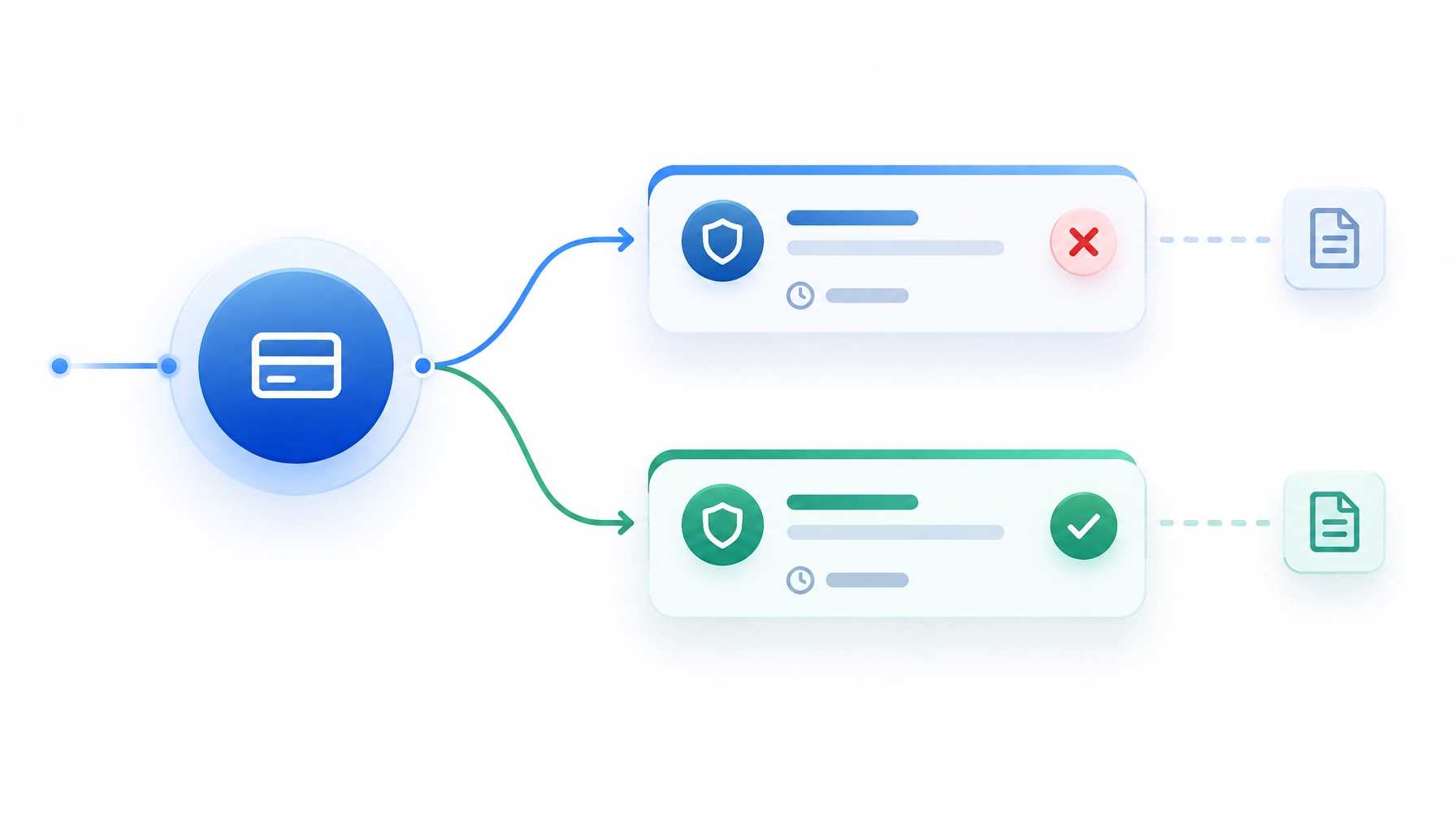
A single cascaded transaction, step by step
- A customer submits a card payment. Provider A sends the authorization request and returns a decline.
- The system records the original response and classifies it using the relevant provider- and scheme-specific rules.
- The decline is confirmed as eligible for another attempt; the transaction is not already approved, pending or of unknown status.
- The system selects a different approved route that supports the transaction’s market, currency and payment details.
- Provider B attempts authorization. The payment is approved or declined, and the final customer-facing status is updated.
- Both attempts are logged against the same order or payment intent, with separate attempt records for support and reconciliation.
Why decline classification is the whole game
A decline code can be a strong signal, a broad category or an ambiguous response. Exact meanings and retry implications vary by provider and scheme. A classification table should therefore be configured and maintained for the merchant’s actual provider connections, not treated as a universal lookup table.
| Decline category | Representative examples | Could another route help? |
|---|---|---|
| Technical or route-related | A provider-specific processing error; a confirmed failure before the request reached the authorization stage | Possibly, if the outcome is known and the alternative route is available |
| Soft or temporary | A response the relevant provider or scheme identifies as retryable | Sometimes, subject to the applicable rules and a defined retry limit |
| Hard or cardholder-side | Invalid account details, lost or stolen card, or genuinely insufficient funds | Usually not through an immediate alternative-provider attempt; follow the response-specific guidance |
| Business or issuer restriction | An issuer block or restriction tied to the merchant, transaction or cardholder | Usually not. A different route does not remove the underlying restriction |
| Indeterminate | “Do not honour,” or a timeout after submission where the outcome is unknown | Do not assume it is retryable. Resolve the status or follow the specific provider guidance first |
“Do not honour” is especially easy to misread. It does not, on its own, establish that another route is safe or likely to succeed. The responsible action depends on the response details, provider configuration and applicable scheme rules.
Set rules that stop as well as retry
A well-governed cascade defines eligible responses, an attempt cap and stop conditions before it goes live. When a response is explicitly non-retryable, authentication fails, or the transaction appears approved, pending or unknown, stop and resolve the state rather than launching another authorization.
For a clearly eligible decline, one additional same-session attempt is a cautious starting point, not a universal scheme limit. Any broader or deferred retry policy needs separate rules, monitoring and confirmation against the relevant provider agreements and scheme requirements.
Choose the next route only if it fits the transaction’s method, market, currency and merchant approval. Cost, provider health and relevant performance for a comparable transaction segment may also inform the order. If the original attempt timed out after submission, check its status before creating another: it may already have been approved.
Immediate or deferred retry?
An immediate cascade may keep a customer in checkout, but another visible attempt can add delay and uncertainty. A deferred retry may be more appropriate for some temporary failures, but it should not happen silently or repeatedly without a reason.
A “failed” message shown before the first attempt is resolved can prompt the customer to pay again, increasing the chance of duplicate authorizations. The customer experience is part of retry cost, not a separate concern.
What cascading can recover, and what it cannot
| A cascade may help with | A cascade cannot fix |
|---|---|
| A confirmed technical failure or a permitted, potentially route-dependent decline | A genuinely invalid, lost or stolen card |
| A retryable response where another approved route is suitable | A hard issuer block or restricted merchant category |
| Certain temporary problems, when the response and retry timing allow another attempt | A failed authentication that requires the cardholder to complete an authentication step |
| An eligible decline when the first attempt is conclusively unsuccessful | An unknown post-submission outcome until its status is resolved |
The controlling test is not “could another provider be different?” It is “is another attempt permitted, technically safe and supported by evidence that the first attempt did not succeed?”
Costs and risks to budget for
A cascade can incur additional processing or platform costs, depending on the provider agreements. It can also create duplicate authorizations or temporary cardholder holds if the original result is unresolved or two routes both approve. Reversals may not remove a hold immediately.
Repeated declines can also affect provider monitoring and payment operations. Visa’s VAMP, for example, measures fraud and disputes against settled card-not-present transactions; from 1 April 2026, the excessive-merchant threshold is 150 basis points in AP, Canada, the EU and the US, subject to a monthly minimum of 1,500 fraud and dispute events. This is a fraud-and-dispute monitoring context, not a claim that cascading causes chargebacks. Authorization or enumeration monitoring is a separate concern; ask providers how they monitor retries and declines. See Visa’s VAMP fact sheet and the September 2026 overview from PaymentReview.

Reconciliation, support and measurement
A cascaded payment creates more than one provider attempt for a single order. Keep a stable order or payment-intent reference, separate attempt-level records and each provider’s own transaction reference. Support teams need to see the original decline, the reason for the retry, the second result and any reversal. Finance teams need to reconcile approvals, captures, refunds and reversals against the correct attempt.
To measure performance honestly, compare eligible transactions with a holdout or other suitable control group. Count incremental approvals, then subtract relevant costs and review customer-visible failures, duplicate authorizations and reversals. Do not credit the cascade for payments that would have succeeded on the first route anyway. Recovery rates vary with traffic composition, decline mix, markets and available providers.
A practical implementation order is: visibility → decline classification → conservative rules → limited rollout → measurement → gradual expansion.
Cascade readiness checklist
- Provider-specific decline mappings are documented and maintained.
- Unknown outcomes are resolved before another authorization is sent.
- Retry eligibility and immediate stop conditions are explicit.
- An attempt cap is set and enforced.
- Each attempt can be traced to the order and provider transaction record.
- Routes are approved and suitable for the relevant market, currency and method.
- Reversals, refunds and customer support procedures are defined.
- Results are compared with a control and include costs and customer impact.
Payvea provides unified payment gateway infrastructure connecting businesses to supported acquiring, PSP and alternative-payment partners through one integration. Its gateway includes smart routing and failover logic, centralized transaction reporting and monitoring, and technical onboarding support. Available routes depend on provider approval, provider capabilities, supported markets and merchant profile. Payvea provides payment technology infrastructure; it is not a bank or direct acquirer and does not independently approve merchant accounts. Learn more about Payvea’s payment gateway and global acquiring through partners.
Frequently asked questions
What is payment cascading?
It is a controlled attempt to process a declined payment through another eligible route, when the response and applicable rules permit.
Is payment cascading the same as retrying a payment?
Cascading is one form of retry: it sends a subsequent attempt through another route. A retry may instead use the same provider or occur later. The response, status and rules determine what is appropriate.
How many times can a transaction be cascaded?
There is no universal number that applies to every provider, scheme, merchant or decline. One additional same-session attempt is a cautious starting policy for clearly eligible declines; confirm any broader policy with providers.
Does cascading improve approval rates?
It can recover some route-dependent declines, but results are not guaranteed. Measure incremental approvals against a suitable control, net of costs and duplicate outcomes.
Is cascading the same as payment routing?
No. Routing selects the route before an attempt. Cascading considers another attempt after a decline.
What is the difference between cascading and failover?
Cascading responds to an unsuccessful authorization by attempting another eligible route. Failover responds to a route or provider being unavailable.
Does cascading cost more?
It can. Additional attempts may incur provider or platform fees, and can add reconciliation and support work. Costs depend on the merchant’s agreements and setup.
Can cascading cause duplicate charges?
It can lead to multiple authorizations or temporary holds if the first result is unknown or more than one attempt is approved. Resolve uncertain statuses before retrying and reconcile every attempt.
Is cascading allowed?
Cascading across providers is normal industry practice, subject to each provider’s agreement and applicable scheme rules. Check the relevant agreement and rules with the provider. This is not legal or compliance advice.
Fewer, better-targeted attempts
Payment cascading is valuable only when the decline is genuinely recoverable and the original attempt is understood. The practical priority is accurate classification, a clear stop rule and attempt-level visibility, not sending the transaction to every available provider.
For a review of your payment routes, retry controls and reporting needs, Request a Payment Review.
Related guides: payment failover and acquiring redundancy; choosing a payment orchestration platform; gateway API vs hosted payment page; payment optimization metrics; orchestration for high-risk verticals.