

Funnel stage: Consideration
A payment provider outage can turn a checkout problem into a revenue and operations problem. A second connection may help, but only if it is genuinely available, suitable for the transaction and ready to take traffic safely.
Payment failover is therefore more than adding another provider to a diagram. It requires a plan for detecting disruption, deciding what can move, managing uncertain transaction outcomes and testing the backup route before an incident occurs.
Key takeaways
- Failover responds to an unavailable or degraded payment path; it is different from initial routing and from cascading after a decline.
- Redundancy is useful only when the alternative route is independently available and supports the relevant merchant, market, currency and payment method.
- Connection errors and provider availability are useful signals, but unusual declines need investigation before being treated as an outage.
- Some parts of a payment flow can move between providers; approvals, underwriting, settlement arrangements, tokens and authentication may not.
- Regular tests and clear incident ownership matter as much as the number of provider connections.
Payment failover, routing and cascading are different
These terms describe related but distinct decisions:
- Routing selects a suitable route for a transaction before its first authorization attempt. See how smart payment routing works.
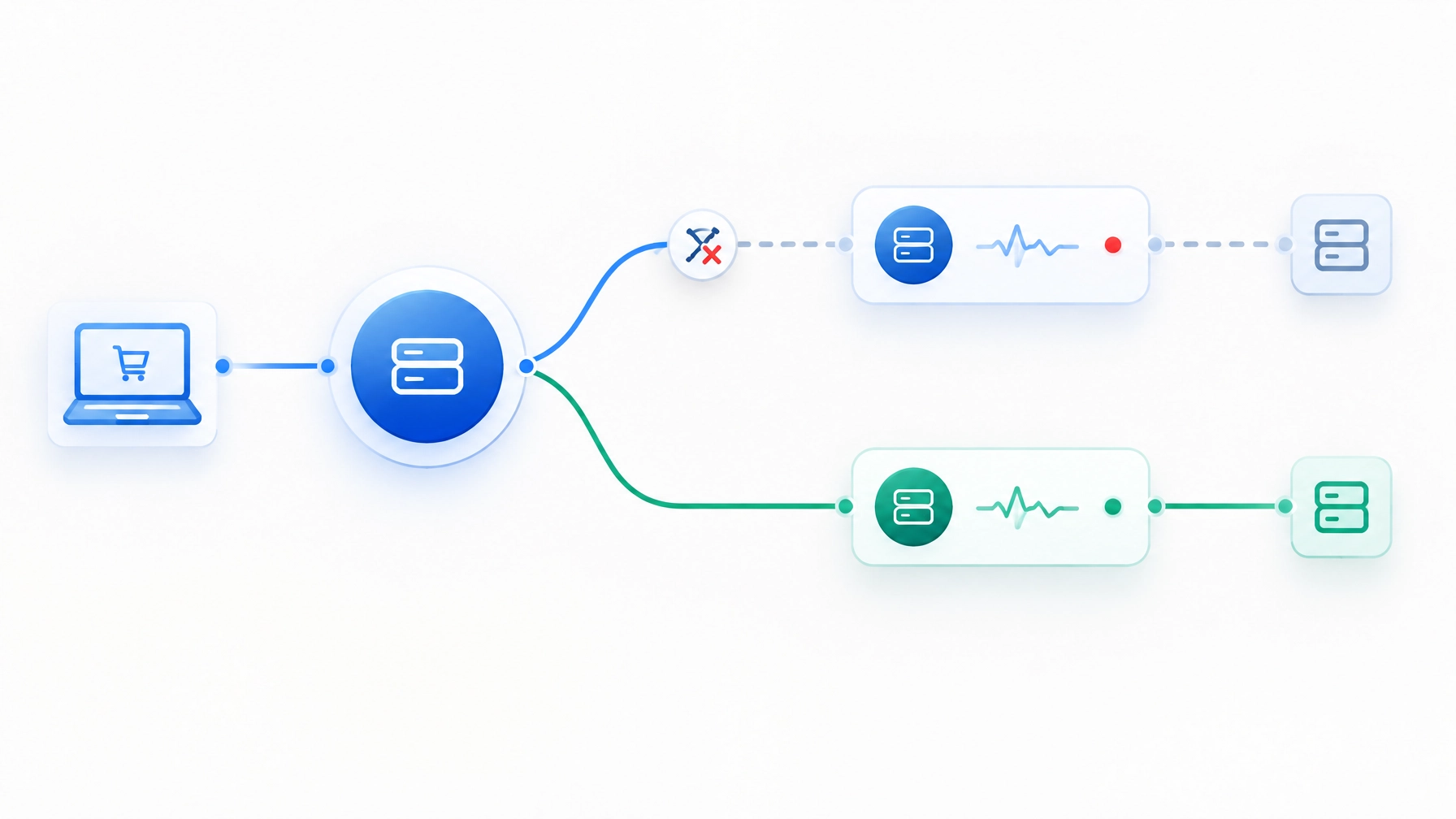
- Failover switches eligible traffic to an alternative route when a provider or connection is unavailable or materially degraded.
- Cascading considers another authorization attempt after an unsuccessful response, when that response and applicable rules allow it. The payment cascading guide covers that recovery process.
Failover is not a general instruction to retry every declined payment. A provider outage may cause timeouts or technical errors; ordinary issuer declines can continue even when every system is healthy. The broader payment orchestration guide explains how these capabilities fit into the wider payment stack.
What makes acquiring redundancy meaningful?
A second connection is not necessarily a second independent path. Two routes might depend on the same gateway, cloud service, network connection, credentials or upstream processing partner. If a shared dependency fails, both paths may be affected.
When assessing redundancy, map the components between checkout and authorization, then identify where dependencies overlap. Consider the gateway or orchestration layer, the processor and acquiring relationship, communications and credentials, and any authentication or token services required by the transaction.
A merchant might use two paths at once, or keep one as a standby. An active setup can reveal operational issues sooner but requires careful management of traffic and reconciliation. A standby path may be simpler to operate, but it can be unready when needed if credentials, configuration or integrations have become stale.
Neither model is automatically resilient. The right design depends on the merchant’s architecture, providers and operational capacity.
The roles in this chain also matter. A gateway, processor, PSP and acquirer perform different functions; adding a gateway connection alone does not necessarily create independent acquiring capacity.
Detect disruption without mistaking normal declines for an outage
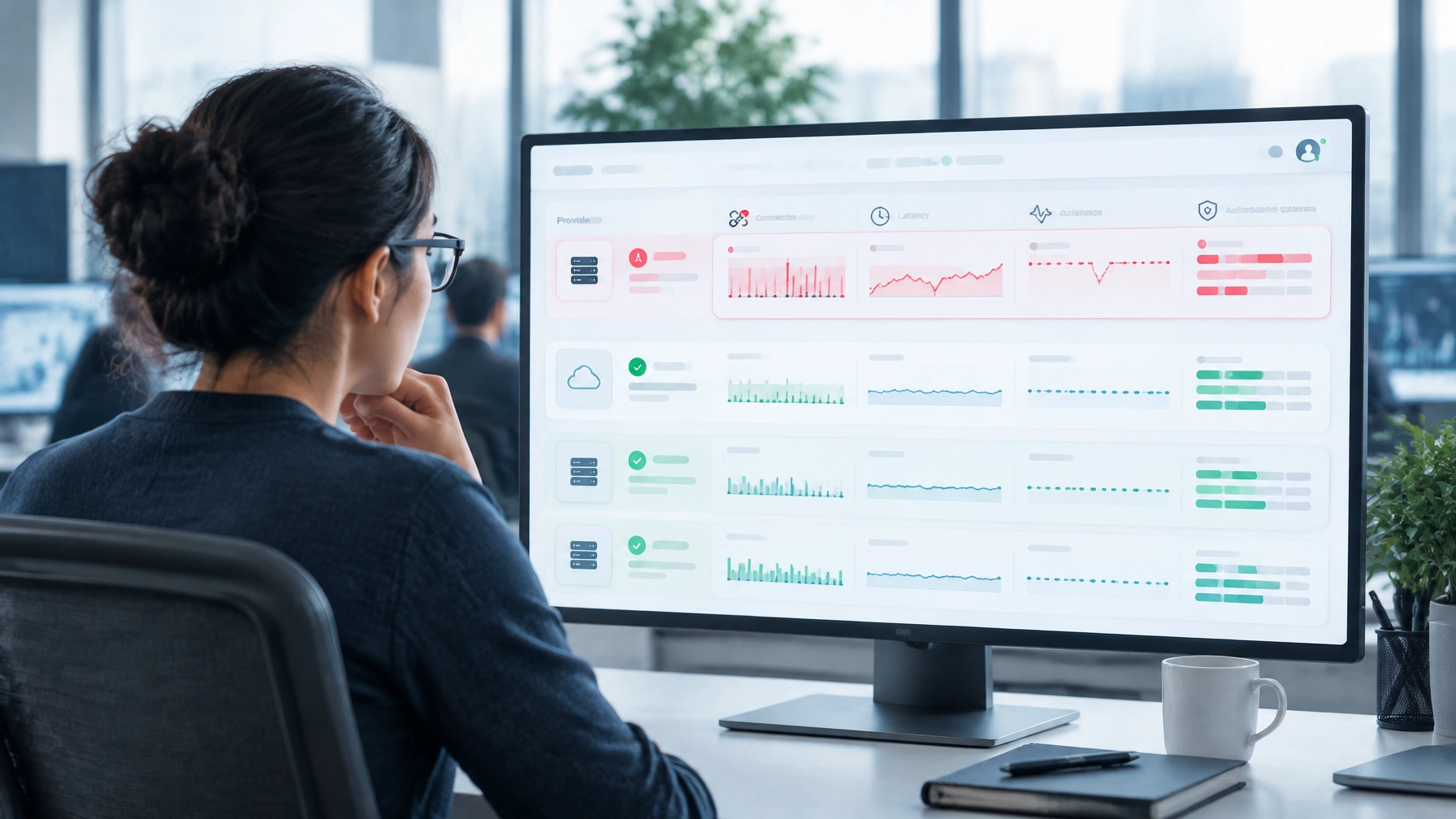
A health check that confirms a website is reachable does not prove that payments can be authorized. Monitoring should reflect the actual transaction path and should be broken down by provider and, where useful, market, currency, payment method and transaction type.
Useful signals include:
- Connection, DNS, TLS and timeout errors
- Gateway or provider availability and response latency
- Technical error rates and delays in transaction-status updates
- Authorization outcomes and the mix of decline reasons
- Capture, refund or settlement delays that may indicate a wider operational issue
Connection errors or an unavailable gateway are relatively direct signs of technical trouble. A sustained decline-rate anomaly is less straightforward. A change in customer mix, issuer behaviour, seasonality, fraud controls or checkout activity can affect declines without indicating that a provider is down.
Set a baseline for normal conditions and compare like with like. Investigate a decline anomaly alongside technical errors, response patterns and provider communications rather than using a single threshold as an automatic instruction to move all traffic. Alert thresholds should be calibrated to the merchant’s own traffic and provider behaviour.
Decide what can, and cannot, fail over
A backup route can preserve access to parts of the payment stack, but providers are not interchangeable. Before relying on failover, document what the alternate route supports and where a change of provider alters the transaction flow.
| Payment element | What to check before failover |
|---|---|
| Provider availability | Is the alternative route integrated, enabled and operational? |
| Market, currency and method | Does it support this transaction in the relevant market, currency and payment method? Coverage varies by provider and merchant profile. |
| Merchant approval | Is the merchant approved for the activity and traffic being moved? A connection does not itself establish provider approval. |
| Settlement | Could the alternative involve different settlement currencies, timing, fees or terms? These depend on the provider and the approved arrangement. |
| Stored credentials and tokens | Can the token be used on the alternative route? Tokens are not necessarily portable across providers. |
| 3D Secure and other authentication | Can the alternative handle the authentication state and required data for this transaction? A route change must not skip an applicable authentication step. |
The issuer still makes the authorization decision. Moving an eligible transaction to a different path cannot guarantee approval, fix an invalid card or override provider underwriting. For businesses reviewing global acquiring options through partners, route eligibility and settlement terms should be confirmed for the specific business and markets.
Build incident ownership into the design
During an outage, teams need to know who detects it, who can activate failover and who communicates with the affected provider. These responsibilities should be agreed between the merchant’s engineering, payments and operations teams and the relevant providers.
A practical incident plan identifies:
- Detection owner: who monitors the signals and raises the alert.
- Decision owner: who can activate, pause or reverse the failover.
- Provider escalation path: which support or incident channel to use and what information to supply.
- Customer and internal communication: who coordinates updates if checkout is affected.
- Reconciliation owner: who reviews uncertain transactions, duplicate attempts and outstanding captures or refunds.
Set an explicit threshold for human escalation and document how operators can disable an unsuitable route. A payment issue may involve more than one provider, so the runbook should capture transaction references, timestamps, errors and affected segments without exposing sensitive payment data unnecessarily.
Treat unknown transaction outcomes carefully
A timeout does not always mean an authorization failed. The provider may have processed the request even if the response did not reach the merchant. Sending the same payment through another route before resolving that status can lead to duplicate authorizations or customer confusion.
For each payment, retain a stable merchant order or payment reference and record each provider attempt separately. Use the status-checking, idempotency or inquiry mechanisms supported by the relevant integration. If the first attempt’s outcome is unknown, resolve or manage that uncertainty according to the provider’s process before initiating another authorization.
This is an important distinction between outage failover and payment recovery: restoring a path should not create uncontrolled duplicate attempts. For detailed retry and decline handling, refer to the cascading guide.
Test failover, not just connectivity
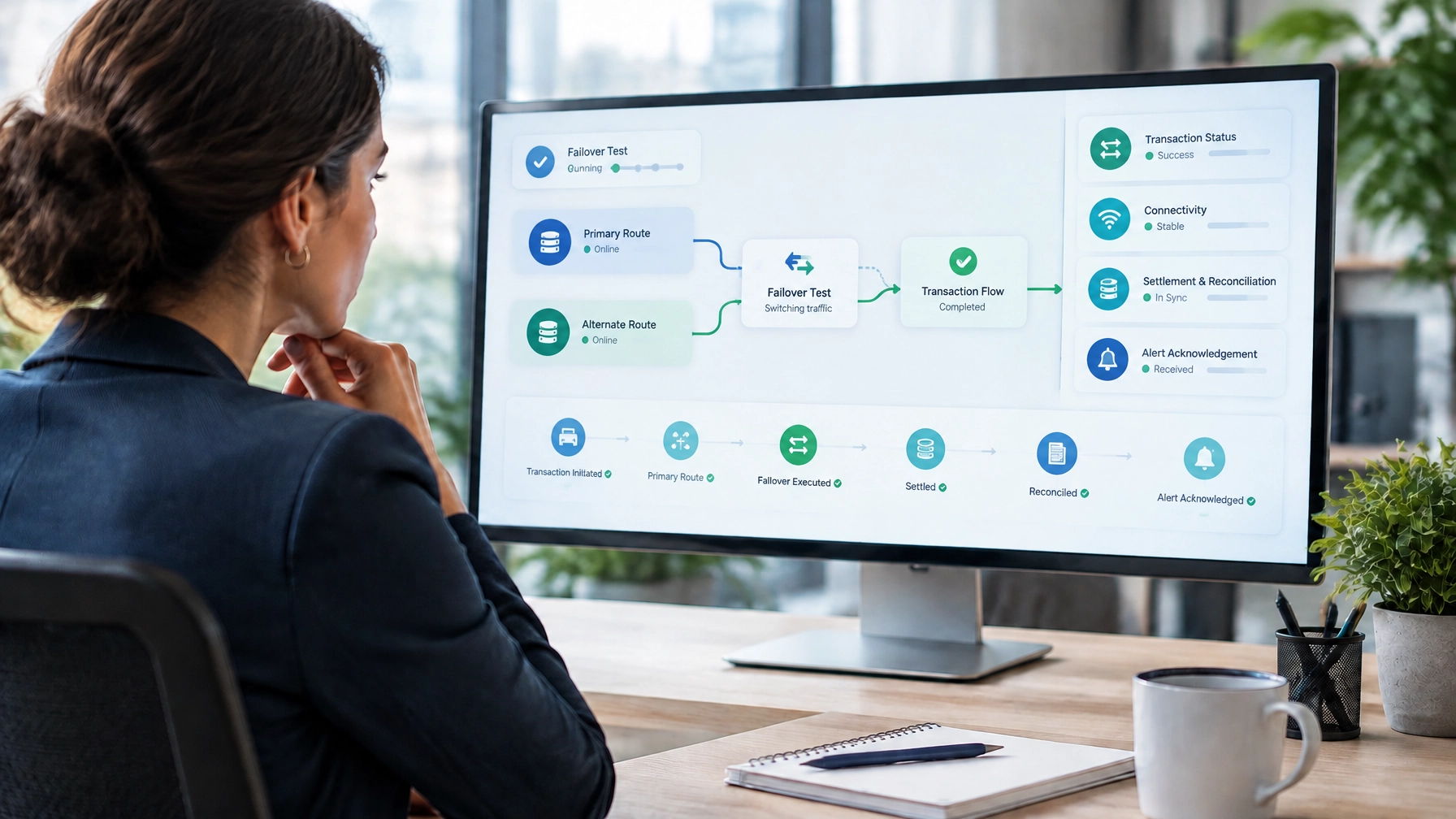
A backup route that has never been exercised is an assumption, not a resilience plan. Testing should cover the real transaction lifecycle and the operational steps around it, not only a successful authorization.
A controlled test plan can include:
- Confirming credentials, routing rules and provider connectivity.
- Testing authorization, capture, void and refund flows where supported.
- Verifying 3D Secure, token and recurring-payment behaviour where relevant.
- Checking alerts, escalation contacts and operator permissions.
- Reconciling transactions across the merchant’s systems and provider records.
- Practising recovery and traffic return once the primary route is healthy.
Document what each test proves, what it does not prove, and who owns remediation. Repeat tests after significant provider, integration or configuration changes. A payment gateway built to connect supported providers can help centralize connections and visibility, but merchants still need to confirm that each configured route is appropriate for its use case.
Redundancy has real operational costs
Additional routes can improve options during an outage, but they also create work and expense. Merchants may need to maintain more integrations, split transaction volumes, reconcile different provider reports and monitor separate response patterns. A standby connection may also carry costs even when it processes little or no traffic.
The extra route can dilute leverage with providers if volumes are distributed, and it does not ensure comparable approvals, settlement terms or support. Most importantly, an available route is not automatically suitable for every transaction. It must support the relevant market, currency, payment method, merchant profile and authentication flow.
The goal is not the largest provider list. It is enough tested, suitable diversity to reduce the impact of a failure without creating more operational risk than the business can manage.
Payvea provides unified payment gateway infrastructure that connects businesses with supported acquiring and payment partners through one integration. Its gateway includes provider connections and failover logic, with availability dependent on partner capabilities, merchant approval and supported markets. Payvea is a payment technology provider, not a bank or direct acquirer.
For a discussion of how provider diversity, payment connections and operational support may fit a particular stack, Discuss Your Payment Requirements. You can also explore Payvea’s broader payment solutions.